
As wildfire risk rises across Washington, particularly in the wildland-urban interface (WUI), many communities lack comprehensive strategies to reduce risks to values, protect infrastructure, and ensure safe evacuations and recovery. Community Wildfire Protection Plans (CWPPs) provide a crucial framework for mitigating risk and increasing wildfire resilience by serving as collaborative, community-driven plans that outline local priorities.
However, developing a plan is costly, and traditional CWPPs can be relatively static. Ongoing engagement with a plan – in between formal plan updates – is often hindered by a lack of funding and capacity. The need for a new approach has emerged to not only reduce costs but also sustain collaboration, monitor implementation, and adapt plans more organically over time. Alongside a couple of other states across the country, Washington has become an early adopter of the Living CWPP (LCWPP) to address these common challenges.
A Community Wildfire Protection Plan should be more than a document; it should be an ongoing and cyclical process that helps communities adapt, collaborate, and take action over time. The Living CWPP tool gives communities a practical way to keep their plans relevant, track implementation, and build on the work they've already accomplished.
Sophia Fox, Natural Hazards Planner (WRCD)
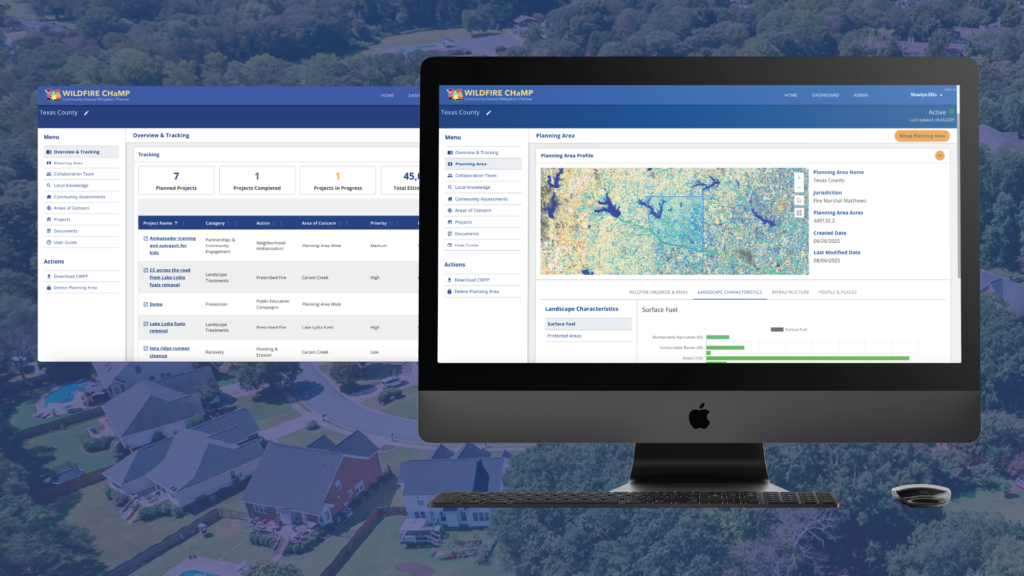
Progress is difficult to track with so many partners working across diverse sectors. Further, conditions and priorities are always changing. Until now, there was no easy way to incorporate changes or regularly monitor progress. As a solution, the Timmons Group has created a cloud-based planning and collaboration platform that supports CWPP creation and implementation by providing a dynamic, data-driven set of tools.
The platform has been customized to our state’s processes and challenges based on input gathered from state agencies, planners, conservation districts, and wildfire practitioners. Washington Resource Conservation & Development (WRCD) and the Washington Department of Natural Resources (DNR) will be providing ongoing technical assistance to anyone wanting to incorporate this new mechanism into their planning and risk mitigation. The goal is not to create more work, but rather make the work we’re already doing easier to track and build upon.
“As someone who just did a 5-year review of a [CWPP] document that was made by someone else, this would have been a magic wand.”
Robert Walters, Whatcom Conservation District
The Living CWPP tool simplifies the process by creating a shared, user-friendly platform where communities can build, implement, and continuously improve their plans, making planning more collaborative, transparent, and sustainable. It represents an important evolution in community wildfire planning. By making it easier to maintain and develop plans, strengthen partnerships, document progress, and adapt to changing conditions, communities can spend less time recreating information and more time implementing the actions that reduce wildfire risk and build long-term resilience.
Highlights
Integrate local knowledge. One of the greatest strengths of any CWPP is its collaborative nature. Many local stakeholders come together in the creation of one plan. Living CWPP allows communities to capture locally identified hazards, assets, projects, values at risk, and priorities that often are not represented in national or statewide datasets and easily integrate them into planning efforts.
Decreased development costs. Communities can utilize the free LCWPP software instead of hiring a contractor to perform technical writing, mapping, and analysis. Should they desire to develop or update their CWPPs in-house, it provides them with all the tools they might need.
Strengthen collaboration. The LCWPP tool allows partners to work simultaneously on the cloud, allowing for the maintenance of connections amongst partners in between formal updates. In addition, staff turnover is inevitable. By documenting decisions, completed projects, and ongoing priorities in one location, communities can more easily transition responsibilities and maintain continuity over time.
Easily visualize spatial data. Planners and practitioners can easily store and access GIS data. Map generation is quicker and simpler with all customized data layers in one location.
Enhance project tracking. Track and report on completed actions using the LCWPP tracking functionality to bolster monitoring and reporting, which in turn may strengthen grant applications and expand potential funding opportunities. Further, document accomplishments and lessons learned to make future planning efforts smoother.
Seamlessly edit documents. Generate a customizable CWPP document directly from the platform. Partners can edit either a single chapter or the entire document depending on what is needed at the time.
Regularly assess priorities and react to changing conditions. Wildfires are unpredictable. Social, economic, and ecological conditions change constantly. Living CWPP allows planners to adapt to change as it occurs in real time. This tool gives communities the flexibility to incorporate new risk assessments, updated data, completed projects, new priorities, and lessons learned without waiting years for a complete rewrite.
More Information: